Shisha charcoal import regulations for Georgia impose zero import duty on coconut shell charcoal briquettes classified under HS code 4402.20, but the true cost of landing a 20-foot FCL at Poti runs closer to $2,153 per metric ton once ocean freight, THC, 18% VAT, and port agency fees are factored in. The procedure — three mandatory documents, electronic filing through ASYCUDA World, a risk-based corridor system — is among the fastest in the Caucasus. But the real complexity sits in the IMDG Code reclassification that took effect January 2026, which turned this low-value bulk commodity into a fully regulated Class 4.2 DG goods shipment.
This guide covers every line item in the landed cost, every document in the clearance stack, and the procedural steps from vanning at origin to release at the Georgian port gate. If you’ve shipped hookah coals to Turkey or the Gulf and assumed Georgia would be similar — it is, structurally, but there are traps specific to this corridor that I’ve seen catch first-time importers.
Table of Contents
What Is the Total Landed Cost of Importing One Container of Shisha Charcoal to Georgia?
The total landed cost of a 20-foot FCL carrying 20 metric tons of coconut shell charcoal briquettes from Semarang (Indonesia) to Poti (Georgia) is $43,062 — or $2,153 per metric ton — including FOB product value, ocean freight, insurance, Georgian government taxes, port handling, and customs brokerage at April 2026 confirmed rates.
What Assumptions Does This Cost Model Use?
The model uses a single 20-foot FCL loaded with 20 metric tons, FOB Semarang at USD 1,500 per ton. Ocean freight to Poti at USD 5,500. Cargo insurance at 0.5% of C+F. Currency conversion at 1 USD = 2.70 GEL (April 2026). Discharge at APM Terminals Poti. Incoterms basis: FOB (Free On Board) — the buyer assumes risk and cost once the container crosses the ship’s rail at Semarang.
How Is the CIF Value Calculated for Georgian Customs?
Georgian customs calculates import duty and VAT against the CIF value — the sum of the product cost, freight, and insurance — not the FOB price. This distinction is where new importers misestimate their import tax exposure:
- FOB product value: 20 tons × USD 1,500 = USD 30,000
- Ocean freight: USD 5,500 (DG-booked, Semarang–Poti via transshipment)
- Cargo insurance: 0.5% of USD 35,500 = USD 177.50
- CIF value: USD 35,677.50 (or 96,329.25 GEL)
In Georgian context, “import tax” is colloquial shorthand — what you actually pay is import duty (0% for HS 4402) plus VAT (18% on the CIF-plus-fees base). There is no separate “import tax” as a distinct levy.
What Government Taxes and Fees Apply to Charcoal Imports in Georgia?
Georgia imposes 0% import duty on coconut charcoal under HS 4402, an 18% VAT on the inflated CIF base, a flat 500 GEL Customs Service Fee, and a 30 GEL Container Tax — totaling $6,651.58 in government charges per container.
According to WTO tariff profile data (2024) and the U.S. International Trade Administration’s Georgia country commercial guide, the “Wood, paper, furniture” product group has an MFN applied average duty of 0.0% with 100% of tariff lines duty-free.
| Charge | Authority | Amount (USD) | Status |
|---|---|---|---|
| Import duty (0% × CIF) | Revenue Service of Georgia | $0.00 | Confirmed |
| Customs Service Fee (Decree No. 96) | Revenue Service of Georgia | $185.19 (500 GEL) | Confirmed |
| Container Tax | Revenue Service of Georgia | $11.11 (30 GEL) | Confirmed |
| VAT (18% of CIF + duty + service fee) | Revenue Service of Georgia | $6,455.28 (17,429.27 GEL) | Confirmed |
| Subtotal government charges | $6,651.58 |
The Customs Service Fee is a flat 500 GEL for declarations exceeding 15,000 GEL — a tiered flat charge under Decree No. 96, not a percentage. VAT is calculated on the CIF value plus duty plus the customs service fee combined. That sequential stacking adds roughly $90 extra compared to calculating VAT on CIF alone.
How Much Are Port Handling and Terminal Charges at Poti and Batumi?
DG classification adds a $45 premium over standard dry containers. A Class 4.2 container at APM Terminals Poti costs $445 in THC versus $400 for general cargo, reflecting segregated stacking, compressed free time, and port liability exposure.
| Charge | Collected by | Amount (USD) | Status |
|---|---|---|---|
| THC (destination, DG rate) | APM Terminals Poti | $445.00 | Confirmed |
| Delivery Order fee | Shipping line agent | $60.00 | Estimated |
| Customs manifest documentation | Shipping line agent | $30.00 | Estimated |
| Administrative / port security fee | Shipping line agent | $50.00 | Estimated |
| Subtotal port/agency | $585.00 |
At Batumi, BICT applies a base rate of $267 plus a 50% IMDG surcharge, landing at $400.50 — marginally cheaper on THC, but fewer direct carrier calls on the Far East–Black Sea rotation limit scheduling flexibility.
How Much Does a Customs Broker Cost in Georgia?
Customs brokerage in Georgia averages 400–500 GEL ($148–$185) for standard commercial clearance. Georgia’s CCZs operate 24/7 and allow direct importer filing, but navigating the RS.ge portal and defending HS code classification on a DG shipment without professional help is inadvisable for a first import.
What Is the Final Landed Cost Breakdown?
| Category | Amount (USD) |
|---|---|
| FOB commodity value | $30,000.00 |
| Ocean freight | $5,500.00 |
| Cargo insurance | $177.50 |
| Government taxes & fees | $6,651.58 |
| Port & terminal charges | $585.00 |
| Customs brokerage | $148.15 |
| Total landed cost (port gate) | $43,062.23 |
| Landed cost per metric ton | $2,153.11 |
Inland trucking from Poti to Tbilisi adds $200–$400. Retail hookah charcoal prices in the Caucasus and Turkey range from $3–$8/kg. At $2.15/kg landed, the margin structure works — if hidden costs don’t erode it.
What Determines the FOB Price of Indonesian Coconut Charcoal Briquettes?
The FOB price is a function of ash content, shape, burning time, and packaging format — ranging from $1,100/ton for standard grade to $1,600+/ton for platinum grade with full retail packaging.
Which Quality Specifications Drive the Price?
Ash content is the primary differentiator. Standard-grade coconut shell charcoal briquettes (2.5–3.5% ash) trade at $1,100–$1,300/ton FOB. Premium grades (1.9–2.5% ash): $1,250–$1,500. Platinum (under 1.9% ash): $1,400–$1,600 with retail packaging. Since late 2024, raw coconut shell shortages across Central Java pushed all tiers upward; some premium suppliers quoted $1,950/ton by end of 2025.
Three additional specifications define the product for B2B buyers:
- Shape and size. The Georgian and Turkish hookah lounge market uses cube-shaped briquettes in 25×25×25 mm or 26×26×26 mm. Flat briquettes (21×26×26 mm) serve home users. Cubes stack more efficiently during vanning, maximizing container density.
- Burning time. Premium hookah charcoal delivers 60–90 minutes of consistent heat per piece — a function of fixed carbon (75–85% for shisha-grade) and briquette density. Lower-grade briquettes burn 40–55 minutes, unacceptable for commercial lounge use.
- Caloric value. Industry standard: 7,000–7,500 kcal/kg. Higher caloric value means fewer pieces per hookah session and lower per-session cost for the lounge operator.
How Does Packaging Choice Affect Container Utilization and Price?
By choosing bulk packaging (master carton only), you maximize vanning density — a 20-foot container holds close to 20,000 kg. But you sacrifice retail-readiness. By choosing full inner-box branded packaging, you lose 10–15% of capacity (down to 17,500 kg) and add $100–$250/ton to FOB. The flip side: the product arrives shelf-ready.
For the Georgian market, where the supply chain is nascent and wholesale buyers prefer to brand independently, bulk packaging makes the stronger economic case on initial shipments.
How Much Does Ocean Freight Cost from Indonesia to Georgia, and What Is the Transit Time?
All-in ocean freight for a DG-booked 20-foot container from Semarang to Poti runs $5,000–$5,500, with transit times of 35–50 days including transshipment at Singapore or Port Klang.
The routing passes through the Indian Ocean, Suez Canal, Mediterranean, and into the Black Sea. MSC published FAK rates for the Far East to Black Sea corridor at $3,200/TEU and $4,600/FEU effective March 2026 — base rates before surcharges:
- Origin THC at Indonesian terminal: $385–$396
- Fuel surcharges (BAF/LSS): $100–$200
- Carbon emissions surcharge (EU ETS pass-through): emerging cost, still small
- B/L documentation fees: $50–$140
Carrier selection narrows for DG cargo. Confirmed carriers accepting coconut charcoal under UN 1361 on this route: MSC, Maersk, CMA CGM, and OOCL. Some sailings lack DG slot capacity.
How Does Container Tracking Work on This Route?
Most carriers provide real-time tracking via online portals from origin gate-in. Updates typically occur at three points: origin port, transshipment hub (Singapore/Colombo/Piraeus), and arrival at Poti or Batumi. After discharge, visibility shifts to the terminal operator (APM Terminals Poti or BICT) and the Georgian customs portal at RS.ge.
How Did Georgia Build the Caucasus’s Fastest Customs System?
Georgia’s customs clearance — averaging 1–3 business days with same-day express available — is the result of a radical post-2003 overhaul that replaced a paper-based, corruption-prone system with fully electronic processing via ASYCUDA World.
In the late 1990s, Georgia’s customs operated on paper with in-person inspections on virtually every shipment. The World Bank ranked Georgia among the most difficult trade environments in the post-Soviet space. In 2003–2004, the Rose Revolution government fired 15,000 customs officers and rebuilt the system around two principles: radical simplification and electronic processing.
Georgia adopted ASYCUDA (developed by UNCTAD) in 1998, then upgraded to ASYCUDA World in 2015 — fully paperless processing, automated risk management, pre-arrival declaration lodgement. Dead-end approaches that were tried and abandoned include pre-shipment inspection (PSI) regimes (added cost without proportional fraud reduction) and bonded warehouse transit models. The winning formula: reduce tariffs to near-zero, automate declarations, focus enforcement on post-clearance audit.
By 2026, over 90% of commercial shipments clear through the green corridor (immediate release, no inspection). The yellow corridor triggers documentary review only. The red corridor mandates physical inspection. For DG cargo from an unfamiliar origin, expect red corridor on the first consignment.
For charcoal briquettes — a temperature-sensitive DG commodity with 2–3 days of free time at the terminal — the difference between 1-day and 5-day clearance is the difference between zero demurrage and $650+ in punitive storage fees.
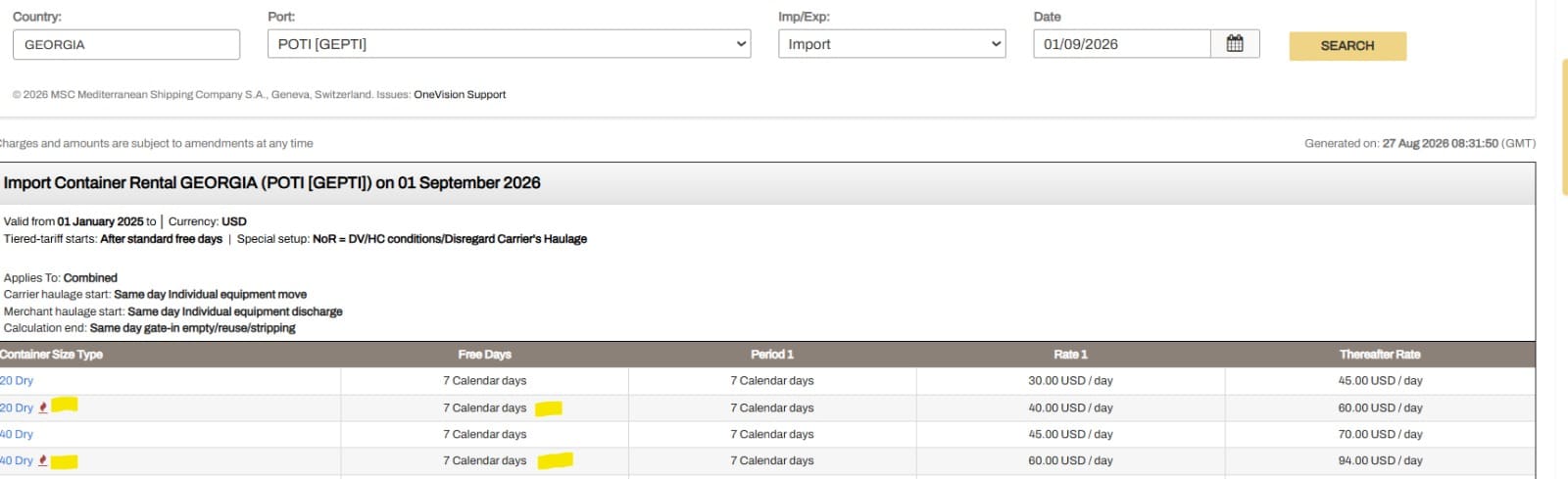
Here you can see the additional charges for container storage, holding at Poti port, for example, for a 40″ft container, the price is 60 USD per day. So you get only 7 free days, and if you do not return the container after 7 days, you have to pay 60 USD per day.
What Documents Are Required to Import Shisha Charcoal to Georgia?
Importing coconut charcoal briquettes to Georgia requires a minimum of three mandatory customs documents (declaration, commercial invoice, transport document), but the full practical stack includes 10 exporter documents, 5 importer documents, and 4 shipping line documents — with the 2026 IMDG framework making documentary failures extremely costly.
Which Documents Must the Indonesian Factory Provide?
- Commercial Invoice. Must state HS code 4402.20 (not 4402.90), unit price, total weight, and Incoterms. Primary valuation basis for Georgian customs.
- Packing List. Net weight, gross weight, carton count, palletization layout. Cross-referenced against port weighbridge readings. Note: coconut charcoal loses 2–4% moisture during 30–45-day transit; experienced exporters declare “Net Weight at Loading” with a moisture-loss note to prevent customs queries.
- Certificate of Origin (COO). Issued by KADIN (Indonesian Chamber of Commerce). Required to verify goods aren’t transshipped from sanctioned territories. A COO stating HS 4402.90 when the Georgian declaration says 4402.20 triggers the red corridor.
- Report of Analysis (ROA). Lab report confirming ash content, moisture, fixed carbon, volatile matter, caloric value. Not a customs requirement, but practically mandatory for B2B verification. Absence is a red flag.
- Self-Heating Test (SHT) Report. Independent lab certification (SGS, Carsurin) proving the batch meets Class 4.2 transit parameters. Required by the shipping line before booking. Not optional since January 2026.
- Vanning Certificate. Marine surveyor’s report confirming IMDG-compliant container stuffing: temperature below 40°C, proper moisture levels, mandatory 30 cm headspace. Think of it as a building inspector’s sign-off: the container is the building, the charcoal is the tenant, the ocean is a 45-day stress test with no fire department on call.
- Material Safety Data Sheet (MSDS). Standard 16-section hazmat document for UN 1361. Must reach the carrier, origin terminal, and destination terminal.
- Weathering Certificate. Proof of minimum 14-day open-air cooling post-carbonization before packaging — the IMDG 42-24 requirement that most directly affects factory production scheduling.
- Fumigation Certificate. Required if wooden pallets are used (ISPM 15). Not required for the charcoal itself.
- Phytosanitary Certificate. Conditional. Carbonized charcoal is technically exempt, but Georgian border control occasionally requests phytosanitary documentation for Chapter 44 “wood” products. The certificate costs $15–$30 in Indonesia; skipping it risks delays that cost 10–50× that amount per day at DG demurrage rates.
Which Documents Must the Georgian Importer Prepare?
- Import Declaration (Form 4). Filed electronically via RS.ge. Generates the tax calculation, assigns the inspection corridor, triggers the release sequence. Your customs broker files this.
- Power of Attorney (POA). Notarized instrument authorizing the customs broker to act before the Revenue Service.
- SWIFT payment confirmation (MT103). If customs challenges your declared CIF value as artificially low, the bank transfer receipt is your fastest defense.
- Transfer Pricing annex. Conditional. Required if the importer and supplier are related entities and cumulative annual transactions exceed 500,000 GEL.
- Certified Georgian translation. Conditional. Customs officers may demand Georgian-language translations if discrepancies are suspected or during Red Corridor inspection.
Which Documents Does the Shipping Line Provide?
- Ocean Bill of Lading (OBL). Must match the Commercial Invoice exactly — weights, goods description, HS code, consignee.
- Dangerous Goods Declaration (DGD). Certifies the cargo as UN 1361, Class 4.2, Packing Group III, per IMDG 42-24 Special Provision 978.
- Arrival Notice. Issued 3–5 days before vessel arrival. Lists destination port charges.
- Delivery Order (DO). Released once all freight and surcharges are paid. Authorizes container pickup.
What Is the Step-by-Step Customs Clearance Procedure in Georgia?
Georgia’s customs clearance follows a 7-step linear procedure — each step gates the next — with total elapsed time of 1–3 business days for clean clearances, processed through the ASYCUDA World electronic system.
Step 1: Pre-arrival registration. Register with the Georgia Revenue Service at rs.ge, obtain a TIN. Any registered Georgian entity can import — no separate “importer license” exists. Apply for ASYCUDA access electronically. One-time step.
Step 2: HS code verification. Confirm HS 4402.20 and 0% duty rate via the Revenue Service lookup tool at rs.ge/CommodityCodes-en. Document this — the printout serves as evidence during Red Corridor challenges.
Step 3: Pre-lodgement. ASYCUDA World allows declaration submission before vessel arrival. Your broker uploads Commercial Invoice, Packing List, OBL, and DGD. The system pre-calculates taxes and assigns a risk score. Not mandatory, but for DG cargo with a 3-day free-time window, it’s the difference between smooth clearance and demurrage.
Step 4: Vessel arrival and discharge. Container enters the IMDG segregated storage area. Free time for Class 4.2: 2–3 days maximum (vs. 7 days for general cargo).
Step 5: Corridor assignment. ASYCUDA assigns one of three channels:
- Green corridor: Immediate release. No inspection.
- Yellow corridor: Documentary review only.
- Red corridor: Physical inspection. Container repositioned, seal broken, cartons examined. Adds $60–$150 in fees plus delay.
Step 6: Payment. Taxes paid to the Georgian Treasury via any bank. Foreign currency converts to GEL at the National Bank exchange rate on declaration day.
Step 7: Release. Revenue Service issues release authorization. Carrier agent issues the Delivery Order. Goods must be declared within 5 working days of arrival or face transfer to state ownership.
Mini-Case: How Pre-Lodgement Saved $780 on a First Shipment
Problem: A first-time importer cleared a 20-foot DG container through Poti without pre-lodging. Red Corridor assignment added 2 days of documentary review. With only 3 days of DG free time, the container accrued 2 days of escalated demurrage at $130/day plus a $150 inspection repositioning fee — $410 in avoidable costs, bringing total port-side friction to $780 after amendment fees.
Solution: On the second shipment, the broker pre-lodged the declaration 5 days before vessel arrival, submitted all documents for preliminary review, and pre-prepared certified Georgian translations. The system assigned Yellow Corridor (documentary review only).
Result: Clearance completed within 18 hours of discharge — zero demurrage, zero repositioning fees. Total savings versus first shipment: $780. Third shipment cleared Green Corridor same-day.
What Did IMDG Amendment 42-24 Change for Shisha Charcoal Shipping in 2026?
IMDG Amendment 42-24, effective January 1, 2026, permanently revoked Special Provision 925, making all coconut shell charcoal unconditionally classified as UN 1361, Class 4.2 (Substances Liable to Spontaneous Combustion) — adding approximately $1,500–$2,000 in additional costs per container versus pre-2026 general cargo shipping.
How Did the Classification Work Before 2026?
Prior to 2026, Special Provision 925 allowed shippers to classify coconut shell charcoal as “non-DG” if a Self-Heating Test result showed the specific batch didn’t meet spontaneous combustion criteria. Factories cherry-picked favorable lab reports. Shipping lines accepted this because enforcement was inconsistent. Charcoal was Schrödinger’s cargo: simultaneously bulk commodity and potential hazmat.
The 2026 framework eliminates that ambiguity. Coconut charcoal is Class 4.2, full stop. The SHT is still required but no longer serves as an exemption mechanism.
What Does This Cost the Importer?
The reclassification addresses genuine safety risks — container fires during long-haul equatorial voyages — but imposes direct costs: by choosing full DG compliance for the sake of maritime safety, we inevitably sacrifice cost efficiency:
- Ocean freight increases $800–$1,200 per container versus general cargo rates
- THC carries a DG premium ($445 vs. $400 at Poti; $400.50 vs. $267 at Batumi)
- Free time compresses from 7 days to 2–3 days
- Carrier selection narrows — not every line accepts Class 4.2
- Documentary burden rises — SHT, Vanning Certificate, Weathering Certificate, DGD, MSDS all mandatory
If your Indonesian supplier proposes shipping as general cargo — walk away. Discovered DG mis-declaration means container rejection at origin, forced offloading at transshipment, maritime authority blacklisting, and penalties exceeding $4,000 per infraction.
What Do Key Logistics Terms Mean for Your Final Import Cost?
Several trade logistics concepts interact in non-obvious ways that directly affect the landed cost of shisha charcoal in Georgia. Each term below has a measurable impact on the final price per kilogram.
What Are THC (Terminal Handling Charges) and Why Do They Vary?
THC is levied by the port terminal operator — not the shipping line — for loading (origin) or unloading (destination) of your container. At origin in Indonesia: $385–$396/20ft. At Poti destination: $445 for DG cargo. THC at destination is added after CIF value is established — it does not inflate the VAT base.
What Is Vanning and How Does Overload Create Risk?
Vanning is physically stuffing the container at the factory. Under IMDG rules, a certified marine surveyor must verify temperature, moisture, headspace (30 cm), and weight distribution, producing the mandatory Vanning Certificate.
Overload — exceeding the container’s maximum gross weight of 24,000–28,080 kg (including ~2,200 kg tare) — is caught by Georgian port weighbridges. An overloaded container is held until excess cargo is removed, at the importer’s cost. Most shipments load 18,000–20,000 kg to stay safely within limits.
What UN Packaging Requirements Apply to Coconut Charcoal?
Coconut charcoal under UN 1361 is Packing Group III — the lowest hazard tier. UN-specification packaging (rigid drums) is not required. Standard commercial packaging (cardboard cartons, shrink-wrapped pallets) is acceptable, but outer packaging must bear DG markings: UN number, proper shipping name, class label, and Packing Group designation.
How Does Georgian Import VAT Recovery Work?
The 18% VAT is not a dead cost for VAT-registered entities. Input VAT on imports is fully recoverable through quarterly offset — credited against VAT collected on domestic sales. The effective net import tax burden approaches zero over the medium term. But the $6,455 cash outlay at clearance creates a 90-day float costing roughly $80–$100 at Georgian commercial lending rates.
What Is Reverse Charge VAT on Foreign Services?
If the Georgian importer engages a non-resident logistics provider, freight consultant, or quality inspector, Georgia applies Reverse Charge VAT: the importer must self-assess and remit 18% VAT on the value of those foreign-sourced services. This is separate from import VAT on goods. Miss it, and the Revenue Service adds it during audit, plus penalties.
What Hidden Costs Can Inflate the Landed Price Beyond the Quotation?
The hidden costs on a first-time DG charcoal import can add $800–$2,000 above the standard landed-cost model, driven primarily by DG demurrage, customs valuation disputes, and documentary amendment fees.
Hazardous goods demurrage. General cargo: 7 days free storage at Poti. Class 4.2: 2–3 days. After that, charges escalate from ~$22/day to $130+/day per APM Terminals Poti tariff schedules. Any clearance delay triggers these fees instantly.
Customs valuation disputes. The Revenue Service benchmarks declared values against historical import data. If your $1,500/ton FOB price falls below the system’s reference range, customs may revalue the cargo upward using statistical averages — directly inflating the 18% VAT. Defense: detailed Commercial Invoice specifying grade, ash percentage, and briquette dimensions, backed by SWIFT MT103 matching the invoice amount exactly.
Weight discrepancy disputes. 2–4% moisture loss during transit is normal. The gap between Packing List weight and port weighbridge triggers customs queries. Resolution: official amendment request plus B/L amendment fee of $30–$100.
Origin compliance costs buried in FOB. Indonesian exporters frequently exclude SHT, Vanning Certificate, and Weathering Certificate costs ($200–$400/shipment) from headline FOB, appending them as separate invoice line items before shipping.
Phytosanitary inspection. Georgia’s National Food Agency may inspect any Chapter 44 “wood” product: 100–250 GEL ($37–$93) fee plus 1–2 days delay. Proactively supplying the Phytosanitary Certificate from Indonesia eliminates this risk.
Document amendment fees. B/L corrections for weight discrepancies, HS code fixes, or consignee updates: $30–$100 per instance per document. On a first shipment, 2–3 amendments are common — $60–$300 in friction cost.
Mini-Case: How an HS Code Mismatch Cost $1,340
Problem: An importer filed Form 4 under HS 4402.20, but the Indonesian factory’s COO stated 4402.90. ASYCUDA flagged the discrepancy.
Action: Red Corridor assignment. Container repositioned for physical inspection ($150). Broker filed an amendment request. Shipping line charged $100 for B/L correction. Clearance delayed 3 days total — 1 day within free time, 2 days at escalated DG demurrage ($130/day × 2 = $260). Customs demanded certified Georgian translation of all documents ($200 via urgent translation service). Broker invested 6 additional hours ($180 in supplementary fees).
Result: Total avoidable cost: $890 in direct fees + $450 in demurrage = $1,340. On the next shipment, the importer contractually mandated HS 4402.20 on all origin documents and pre-approved draft copies — clearance proceeded through Green Corridor in under 24 hours.
Which HS Code Should Be Used for Coconut Charcoal in Georgia — 4402.20 or 4402.90?
The correct classification is HS 4402.20 (“Wood charcoal of shell or nut, whether or not agglomerated”). Using 4402.90 does not change the 0% duty rate but triggers ASYCUDA’s risk engine and near-certain Red Corridor routing if documents are mismatched.
The WCO created the .20 subheading specifically to differentiate shell/nut charcoal from bamboo (.10) and general wood (.90). Many Indonesian exporters still default to 4402.90 due to legacy factory systems — both subheadings attract 0% import duty in Georgia, so there’s no duty evasion at stake. But documentary asymmetry between origin and destination documents is the single highest-weight variable in ASYCUDA’s risk algorithm for corridor assignment.
The fix is contractual: mandate HS 4402.20 across Commercial Invoice, Packing List, B/L, and COO. Pre-approve draft copies before originals are printed.
Two reclassification risks: (1) if customs suspects steam-activation, they may attempt reclassification to HS 3802.10 (Activated Carbon) — counter this by stating “Non-Activated” on the Commercial Invoice; (2) if the product contains chemical accelerants (potassium nitrate), it exits Chapter 44 into HS 3606.90 (combustible preparations).
How Does the Poti Free Industrial Zone Eliminate VAT on Charcoal Imports?
Companies operating within the Poti FIZ pay 0% VAT, 0% import duty, 0% corporate income tax, 0% property tax, and 0% dividend tax on imported goods — reducing the landed cost per container by approximately $5,000 (the VAT savings alone) versus standard import clearance.
The Poti FIZ is a 300-hectare facility adjacent to the Port of Poti. Established in 2008, it houses ~100 enterprises focused on trade and re-export. The only tax: a 4% levy on goods sold from the FIZ to the Georgian mainland. Georgia also operates the Kutaisi Free Industrial Zone and Tbilisi Free Zone with comparable tax benefits for inland operations.
How Does FIZ Clearance Differ from Standard Import?
Standard import: $43,062 landed cost, including $6,455 in VAT. FIZ import: zero VAT at entry. Goods enter under a customs suspension regime. If re-exported — to Turkey (FTA), Azerbaijan/Armenia (CIS agreements), or the EU (DCFTA) — the VAT obligation never arises.
Why Is Georgia’s Geographic Position Strategically Valuable for Charcoal Distribution?
No other Caucasus country holds simultaneous FTAs with the EU, Turkey, China, and EFTA states. Turkey — one of the world’s largest hookah markets — sits to the west with zero duty on industrial goods. Azerbaijan and Armenia connect via CIS agreements. The trade-off: by choosing the Poti FIZ for tax-free transshipment, you sacrifice direct Georgian domestic market access (4% mainland levy) and accept FIZ registration overhead. But for multi-market distribution, savings repay setup costs within 2–3 shipments.
There is no FTA between Georgia and Indonesia — irrelevant for imports (MFN rate is 0%), but relevant for re-export: Indonesian charcoal must undergo “sufficient transformation” in Georgia to qualify for preferential treatment under partner FTAs. Simple transshipment does not qualify.
Does Georgia’s FTA Network Affect the Cost of Importing Charcoal?
Georgia’s MFN duty on HS 4402 is 0% regardless of origin — the extensive FTA network has zero impact on import cost but becomes strategically valuable for duty-free re-export to partner countries.
Georgia holds agreements with the EU (DCFTA, 2016), Turkey (FTA, 2008), CIS states including Azerbaijan, Armenia, Ukraine, and Kazakhstan, China (2017), EFTA (2017/2018), Hong Kong, the UAE, and South Korea. Export and re-export are completely free from customs duties.
The constraint: rules of origin provisions define whether goods transiting Georgia qualify for preferential treatment at destination. Re-labeling Indonesian charcoal in a Georgian warehouse and shipping to Turkey under the FTA wouldn’t satisfy “sufficient transformation.” Actual processing — retail repackaging, blending, value-added manufacturing — may be required.
According to WTO tariff profile data, Georgia’s simple average MFN applied tariff is 1.4% (0.7% for non-agricultural goods). Roughly 85–90% of all imports enter duty-free.
What Transfer Pricing Rules Apply to Related-Party Charcoal Imports in 2026?
If the Georgian importer and Indonesian factory share ownership, Georgia’s 2026 transfer pricing rules mandate formal reporting once cumulative controlled transactions exceed 500,000 GEL — a threshold that 5 containers breach comfortably.
As reported by Forbes Georgia, the importer must file an “Information on International Controlled Transactions” annex with the annual CIT return. A single container at ~96,000 GEL CIF represents 20% of that threshold. Non-compliance triggers automatic 5,000 GEL penalties and elevated multi-year audit probability.
For arms-length transactions with unrelated suppliers, this is irrelevant. For vertically integrated operations, it demands a Georgian tax advisor and an OECD-compliant Transfer Pricing Local File establishing the FOB price as a defensible market rate.
A View from the Other Side: Is Georgia Actually Worth the Complexity Versus Importing Directly to Turkey?
The strongest counterargument to the Georgia corridor is straightforward: if your end market is Turkey, importing directly into Turkish ports eliminates the transshipment step, the Georgian intermediary, and the rules-of-origin risk entirely. Turkey’s own import duty on HS 4402 coconut charcoal is 0% under its MFN schedule. Turkish ports (Mersin, Ambarlı) receive direct Far East calls with higher frequency than Poti, meaning shorter transit times and more carrier options. Turkey’s domestic hookah market is 20–50× larger than Georgia’s. The logic of shipping to Georgia first, only to re-export to Turkey second, looks like an unnecessary detour.
This counterargument is valid in one specific scenario: if your only end market is Turkey, and you have no interest in CIS, EU, or Caucasus distribution, then direct import to Turkey is simpler and cheaper. The transshipment through Georgia adds 3–5 days of transit, a second set of port handling charges, and the administrative overhead of Georgian entity registration and FIZ compliance.
Where the argument breaks down is when the distribution footprint extends beyond Turkey. A Turkish-registered importer cannot re-export duty-free to Azerbaijan, Armenia, or EU DCFTA markets with the same ease as a Georgia-based FIZ entity. Turkey’s customs regime, while efficient, is more bureaucratically layered than Georgia’s three-rate, near-zero tariff system — Turkey maintains over 6,500 tariff lines versus Georgia’s simplified schedule. And Turkey’s VAT rate is 20% (vs. Georgia’s 18%), with more complex recovery mechanics for trading companies.
The Georgia corridor’s value proposition is not as a single-market entry point. It is as a multi-market distribution node — the only country in the region with simultaneous FTAs covering the EU, Turkey, China, EFTA, and CIS, combined with a Free Industrial Zone that eliminates VAT entirely on transshipment. For importers targeting 2+ markets from a single entry point, the $5,000 VAT savings per container through the Poti FIZ and the regulatory simplicity outweigh the added transit step. For Turkey-only operations, direct import wins.
What Should a First-Time Importer Prioritize?
After a decade of moving coconut charcoal from Indonesian kilns to ports across the Middle East, Europe, and Central Asia, the Georgia corridor is promising precisely because it’s underserved. No established Indonesia-Georgia charcoal trade flow exists. The nearest existing destinations for Indonesian exporters are Turkey and Russia.
Georgia’s framework is importer-friendly — 0% duty, 1–3 day clearance, minimal paperwork. But DG classification changes everything about operational planning. The margin between “profitable import” and “container trapped at port accruing $130/day” is exactly as wide as your documentary preparation.
Three priorities:
Align every document to HS 4402.20 before printing. Pre-approve drafts. No exceptions.
Pre-lodge the customs declaration before the vessel arrives. With a 2–3-day free-time window, you cannot start paperwork after discharge.
Budget for the Red Corridor on your first shipment. The system treats new importers and new corridors with appropriate skepticism. The second shipment is easier. The third is routine.
At $2,153/ton landed — or ~$1,800/ton through the Poti FIZ — and retail prices of $3–$8/kg across the Caucasus and Turkey, the margin is there. The question is whether execution is clean enough to capture it.
— Greg Ryabtsev
FAQ: Importing Hookah Charcoal to Georgia
Is a Special Import License Required?
No. Any legal entity or individual entrepreneur registered with the Revenue Service and holding a TIN can import coconut shell charcoal briquettes. No commodity-specific licensing exists for HS 4402.
How Long Does Customs Clearance Take at Poti?
1–3 business days via ASYCUDA World. Pre-lodging can achieve same-day release for Green Corridor assignments. First-time DG shipments: budget 3–5 business days for possible Red Corridor inspection.
Can the 18% VAT Be Recovered?
Yes. For VAT-registered entities, input VAT is fully recoverable through quarterly offset against domestic sales VAT. Entities in the Poti, Kutaisi, or Tbilisi Free Industrial Zones pay 0% VAT on imports.
What Is the Exact Import Duty Rate?
Zero. HS 4402.20 and 4402.90 both carry 0% MFN import duty regardless of origin country.
Can Shisha Charcoal Still Ship as General Cargo After IMDG 42-24?
No. Since January 1, 2026, all coconut shell charcoal is unconditionally UN 1361, Class 4.2. Shipping as general cargo constitutes a maritime safety violation with fines exceeding $4,000.
What Is the Maximum Container Load Weight?
Standard 20-foot container max gross: 24,000–28,080 kg (including ~2,200 kg tare). Most shisha charcoal shipments load 18,000–20,000 kg to avoid overload penalties at Georgian weighbridges.
What Is the Sea Transit Time from Indonesia?
35–50 days including transshipment. Route: Singapore/Port Klang → Indian Ocean → Suez Canal → Mediterranean → Black Sea. No direct sailings to Poti or Batumi exist.
How Does the Poti FIZ Eliminate Import VAT?
Goods enter under customs suspension — the 18% VAT is not assessed. If re-exported, VAT never arises. Only mainland sales incur a 4% FIZ-to-domestic levy.